
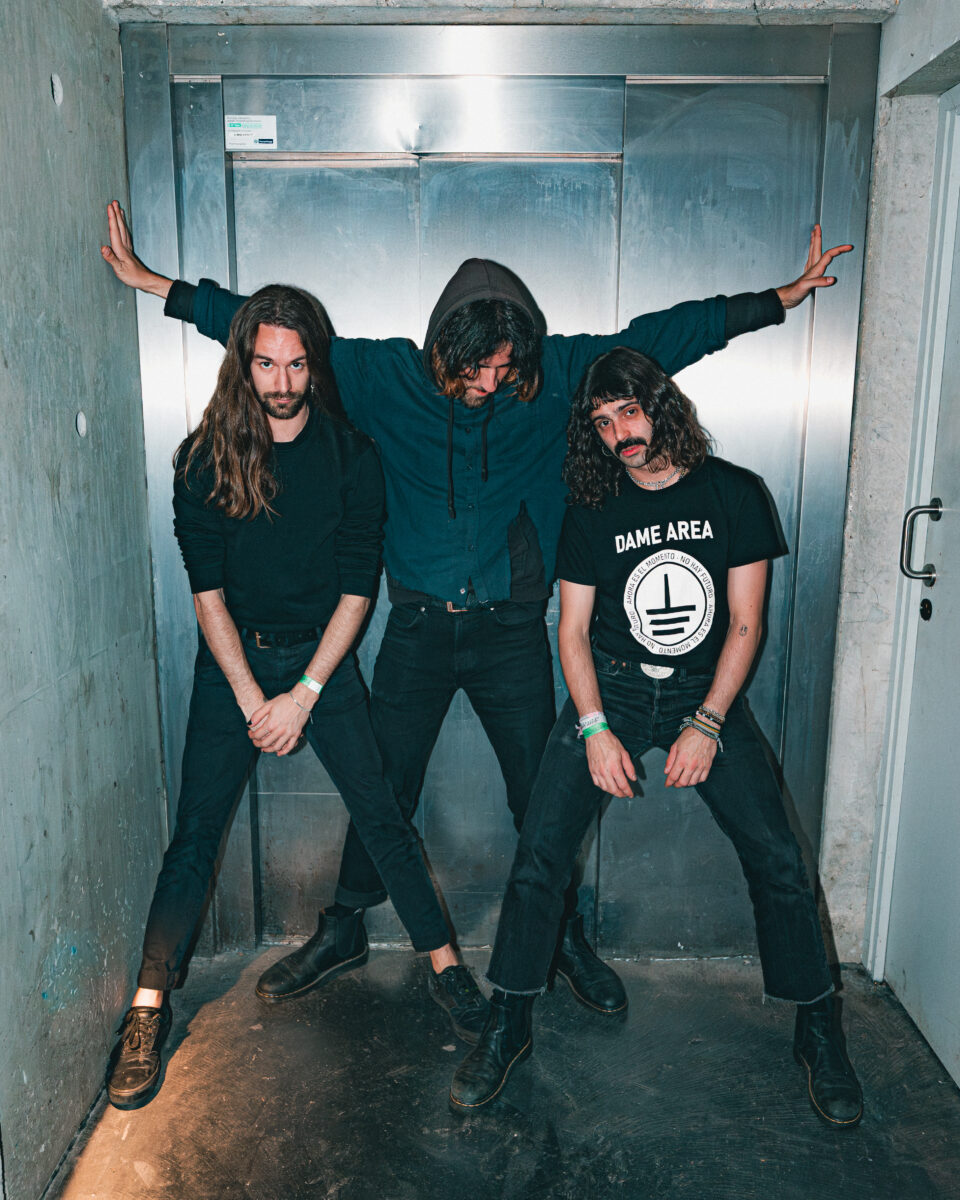
MAQUINA est un trio lisboète qui construit une musique comme une expérience totale. Entre blocs massifs de son(s), improvisations et textures, jusqu’à faire du live un espace de transe où chaque morceau peut muter à tout instant, MAQUINA revient sur sa manière de travailler le mouvement, le volume et l’instinct collectif à l’occasion de sa venue au Foul Weather.

La Face B : Salut MAQUINA, comment allez-vous ?
MAQUINA
João : On va bien !
Halison : Très bien même.
LFB : Pour commencer, j’aimerais savoir : MAQUINA, c’est un sentiment ou un état ?
MAQUINA
João : Les deux ? Oui, bonne question. Je dirais les deux. C’est un état, mais aussi un sentiment. Oui, les deux.
Halison : Oui, davantage comme un mouvement, en fait. Mais un état d’esprit aussi, clairement. Vivre un moment, une expérience.
Mendy : Oui, je pense aussi. C’est un état d’esprit, avant tout. En tout cas pour moi.
João : Moi, j’aime bien l’idée des deux.
LFB : Avec un nom comme MAQUINA, quel rôle donnez-vous à la machine dans votre musique et votre travail ? Parce que j’ai l’impression que ce sont deux choses différentes.
MAQUINA
Halison : Ça peut presque être la même chose. “MAQUINA” veut dire “machine”. C’est le processus de répétition, des engrenages qui avancent ensemble et créent cette répétition, quelque chose qui…
João : Oui, quelque chose qui ne fonctionne pas sans tous les éléments réunis.
Halison : Si une pièce lâche, tout le système tombe en panne, comme une machine. Dans le travail aussi, c’est un peu pareil : si on ne fait pas de musique ensemble dans le même état d’esprit, si on ne ressent pas la même vibration ou la même idée, certaines choses commencent à rouiller et ça fonctionne moins bien. Une machine doit être entretenue, parfois il faut changer certaines pièces pour la rendre plus efficace. C’est pareil pour notre façon de travailler.
LFB : Je vous ai découverts avec vos singles Agony, Pleasure, Pressure. Je sais que vous aviez déjà sorti un album avant, mais je ne vous connaissais pas encore. Ces morceaux sont très physiques. Entre la tension et la transe, qu’est-ce que vous cherchez quand vous créez ?
MAQUINA
João : Pour cet album (BODY TRANSMISSION à venir le 10 juillet prochain chez Fuzz Club NDLR), on voulait quelque chose de très centré sur le club, sur une énergie de musique club. Mais j’aime aussi quand c’est un peu lourd, un peu intense. Donc voilà. On essaye surtout de rendre ça plus dansant.
Halison : Oui, le plus dansant possible, pour faire bouger le corps.
LFB : Comme vous le dites, votre musique inspire le mouvement. Quand on l’écoute, il est impossible de voir des images fixes. Quels types de visuels voyez-vous ?
MAQUINA
João : Beaucoup de textures, c’est sûr.
Halison : Oui. Des nuages.
João : Du grain, des matières, des choses tangibles. C’est un peu abstrait, mais avec des motifs, je dirais.
LFB : Votre dernier clip était très flou…
MAQUINA
João : Oui, justement, les textures.
LFB : Quand vous enregistrez votre musique, on a l’impression qu’elle naît beaucoup du moment présent. Laissez-vous une place à l’improvisation pendant les concerts ?
MAQUINA
Halison : Oui, énormément. Tout repose sur des jams assez ouvertes. On faisait encore plus ça sur les premiers albums.
Même les albums étaient enregistrés comme ça : beaucoup d’improvisation, puis on finissait le disque en studio. On créait un groove, puis on construisait autour. Pendant les répétitions aussi. Ensuite, on allait en studio et on laissait les choses ouvertes pour voir ce qui surgissait sur le moment.
Et en concert, on joue toujours un peu différemment à chaque fois. On ne sait jamais vraiment ce qui va arriver. Parfois il faut improviser, qu’on le veuille ou non : à cause d’une erreur, ou simplement parce qu’on ressent très fort une section du morceau.
João : Et là on se dit : “Allez, on l’allonge aujourd’hui.”
Halison : Moi, j’adore la répétition. Donc si je garde un groove un certain temps et que je sens que tout le monde est dedans, peut-être qu’on va doubler la section, répéter encore et encore… jusqu’à créer cette transe dont tu parlais. Mais tout se décide dans l’instant, plus au ressenti qu’à la réflexion.
LFB : Vous enregistrez vos concerts ?
MAQUINA
Oui.
LFB : Et est-ce qu’il peut arriver que vous repreniez un passage improvisé pour en faire un morceau ? Que vous vous disiez : “Les gars, on tient un nouveau titre.”
MAQUINA
Halison : Oui, ça arrive parfois. Ça peut venir d’une erreur, ou simplement d’une idée improvisée sortie de nulle part. Ensuite on retourne en studio, on développe cette idée et ça devient un nouveau morceau.
LFB : Donc imaginons : ce soir vous jouez Agony, mais dans une nouvelle version. Ça pourrait devenir un morceau totalement différent.
MAQUINA
Halison : Oui, complètement. Ça peut arriver. Tout dépend de la manière dont on travaille les morceaux en répétition et en studio.
Avant, c’était encore plus vrai. Un type est venu me voir un jour et m’a dit : “À chaque concert, parfois j’écoute un morceau et ce n’est qu’au bout de trois ou quatre minutes que je réalise que c’est une chanson que je connais déjà.”
Mais aujourd’hui, surtout avec le nouvel album, on a travaillé autrement. De manière plus “chirurgicale”, en réfléchissant davantage à la structure des morceaux. Du coup, sur scène, on joue plus proche des versions studio.
Mais il y a toujours cette ouverture pour faire autre chose. Ça dépend de notre état d’esprit. Parfois on joue le morceau tel quel, parfois on le transforme un peu. Toujours pour créer cette sensation de club.
LFB : Donc vous pouvez couper des parties, changer l’ordre “normal” des choses parce que ça fonctionne mieux.
MAQUINA
Halison : Oui, parfois.
LFB : J’aimerais aussi comprendre le rapport au volume dans votre musique. En studio, on ne peut pas forcément travailler sur quelque chose de très fort. Mais vos morceaux semblent conçus pour être joués très fort. Comment gérez-vous ça ?
MAQUINA
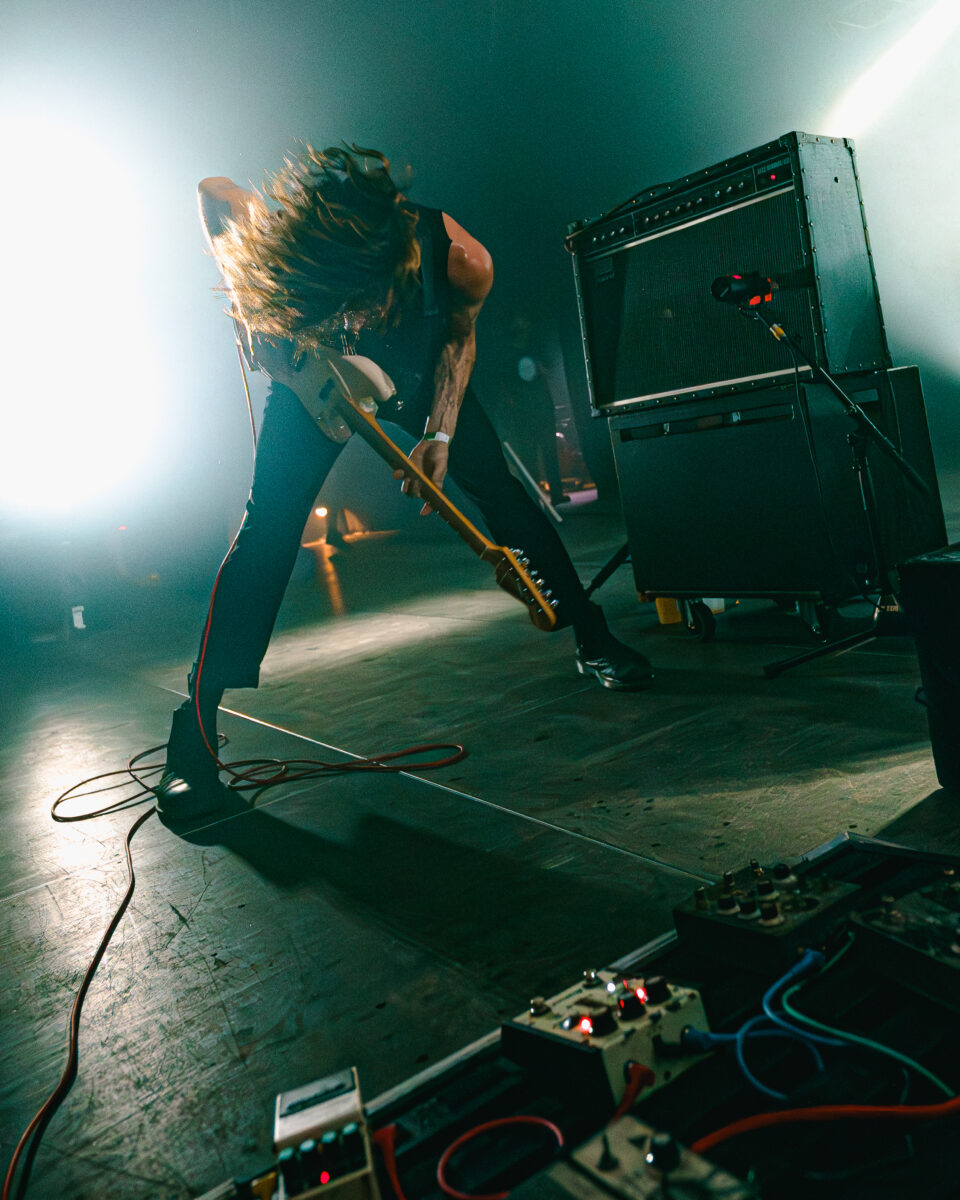
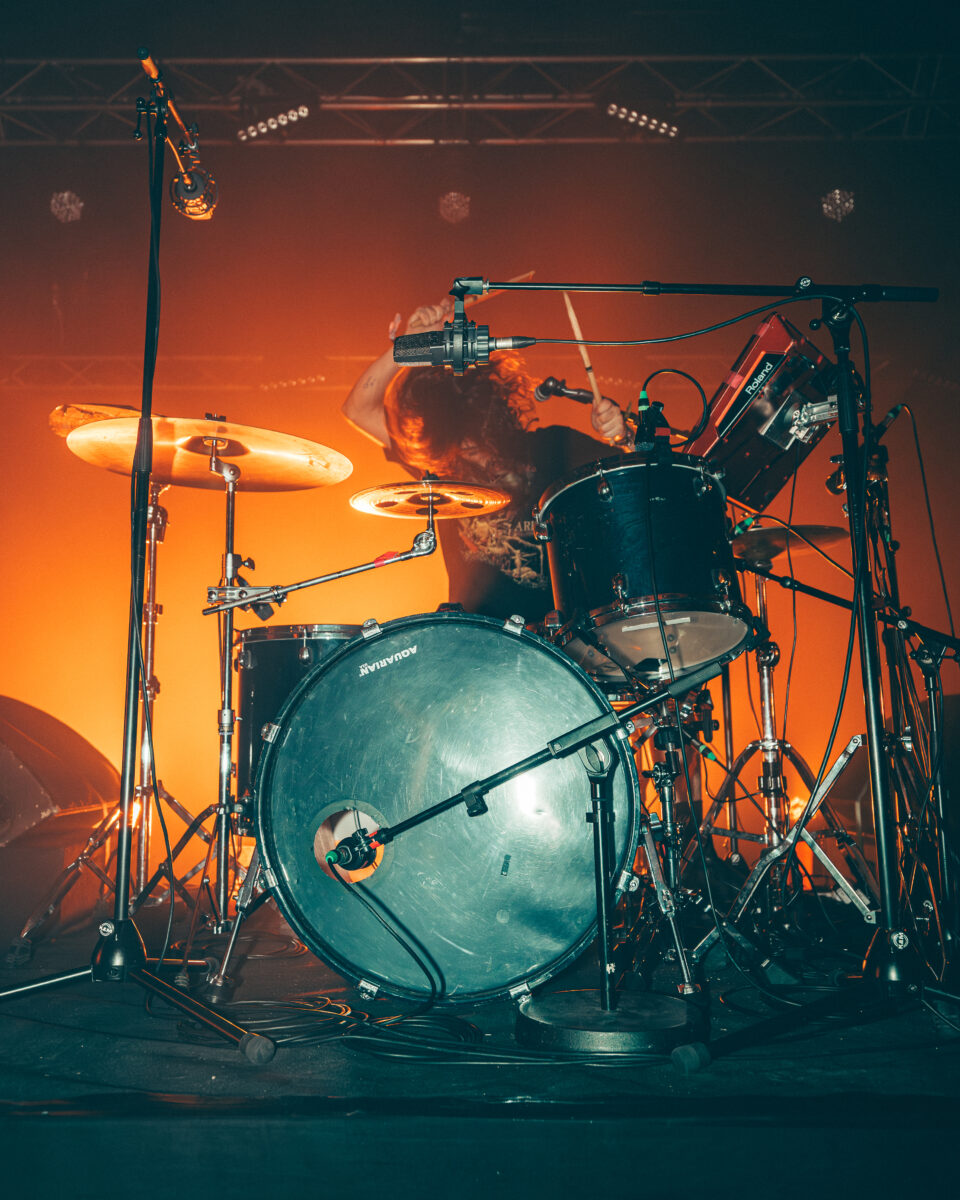
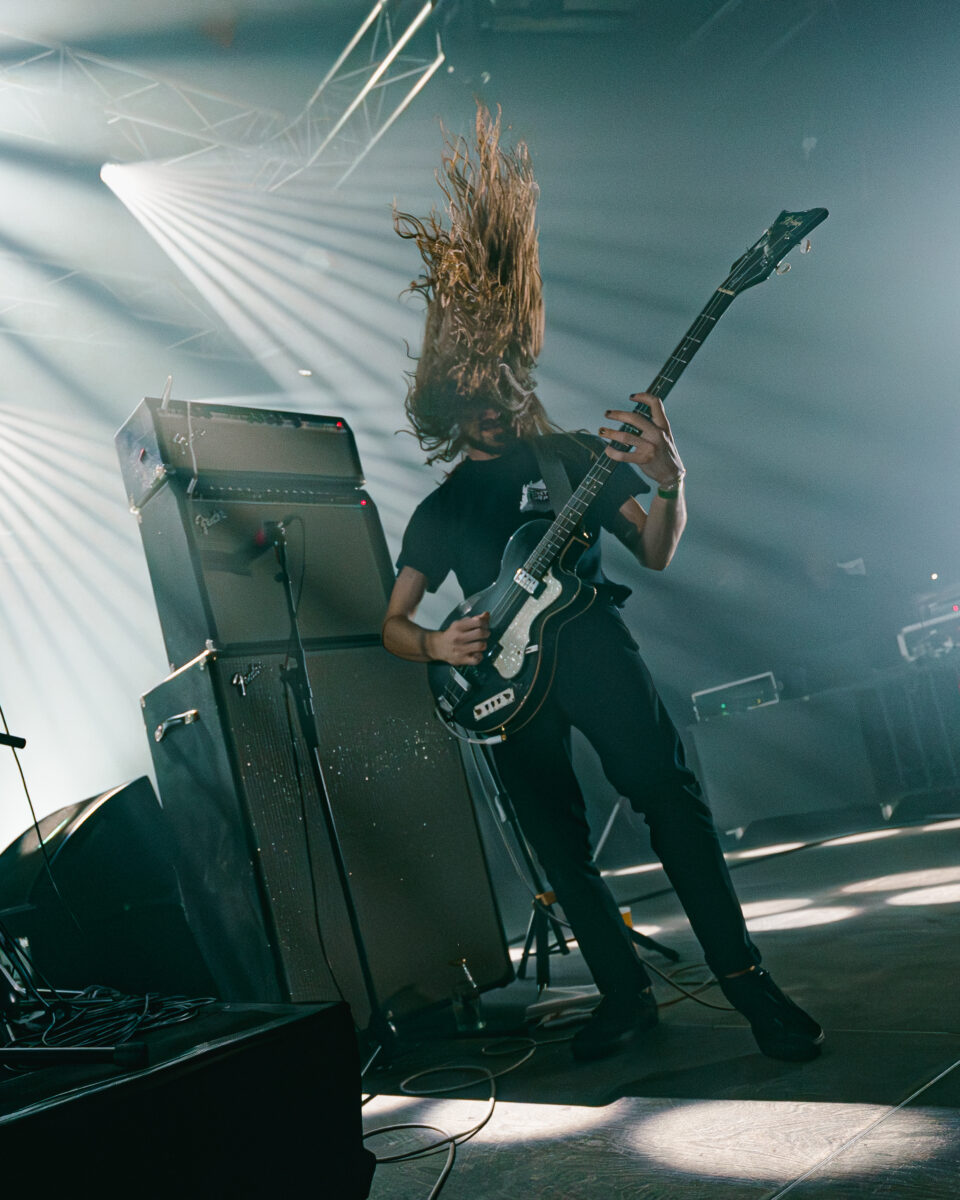
Halison : On joue fort. Tout le monde joue fort. On monte le volume jusqu’au moment où la guitare n’est plus assez forte… alors João monte encore. Puis tout le monde suit, jusqu’à ce qu’une personne dans la maison dise : “Les gars, vous êtes à la limite, on ne peut pas aller plus loin.” Et là on s’arrête.
João : On voit où est la frontière. Ensuite, on travaille avec ça.
LFB : Et après vous vous dites : “OK, maintenant allons encore plus loin.”
MAQUINA
João : Oui. Enfin… parfois on ne peut pas. Mais notre musique demande à être jouée fort.
Halison : Oui. Même les résonances, les feedbacks, tout ce qui se crée autour…
Parfois, si ce n’est pas assez fort, le son perd quelque chose. Il devient trop mince, il meurt.
Mendy : Oui, ça ne sonne plus pareil. Les notes disparaissent. João a beaucoup de mal avec ça : si ce n’est pas assez fort, il faut monter le son. Dit comme ça, ça ressemble à une excuse.
LFB : Vous jouez surtout en intérieur. Est-ce que vous pourriez jouer dehors ? Ou même enregistrer dehors, justement parce qu’il n’y aurait plus de limites ?
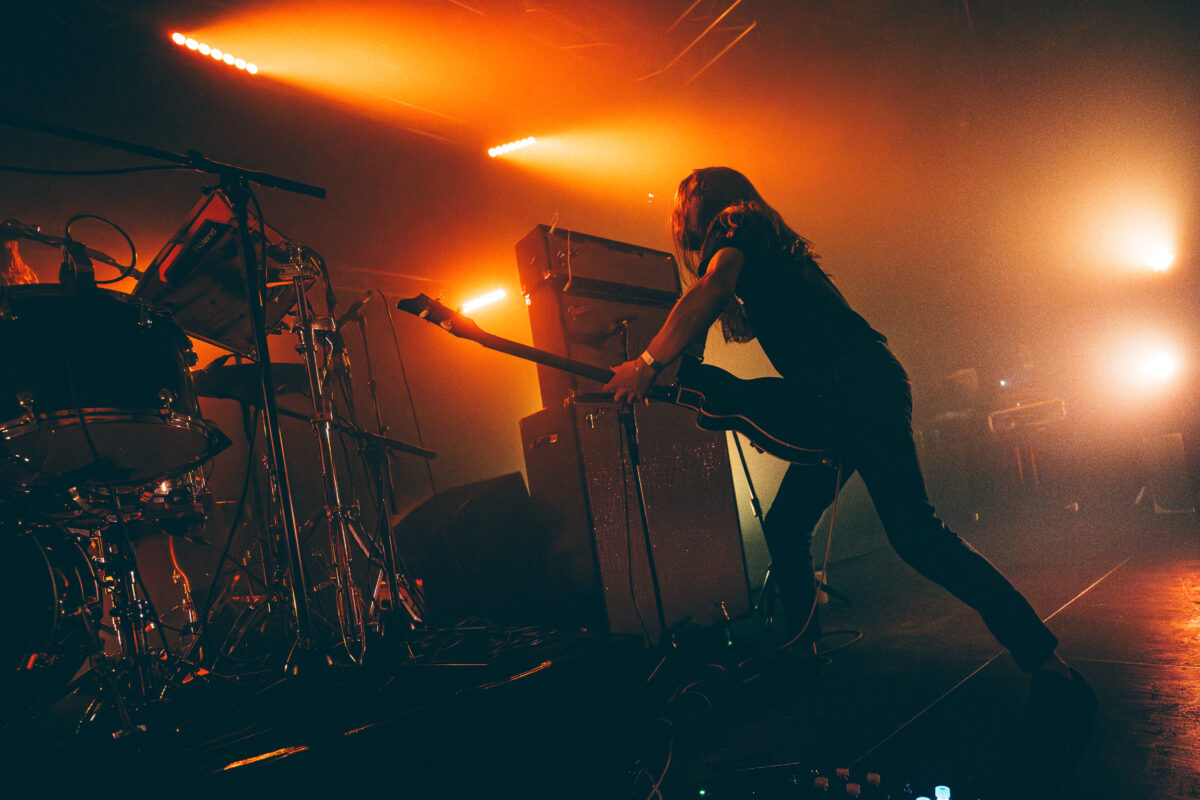
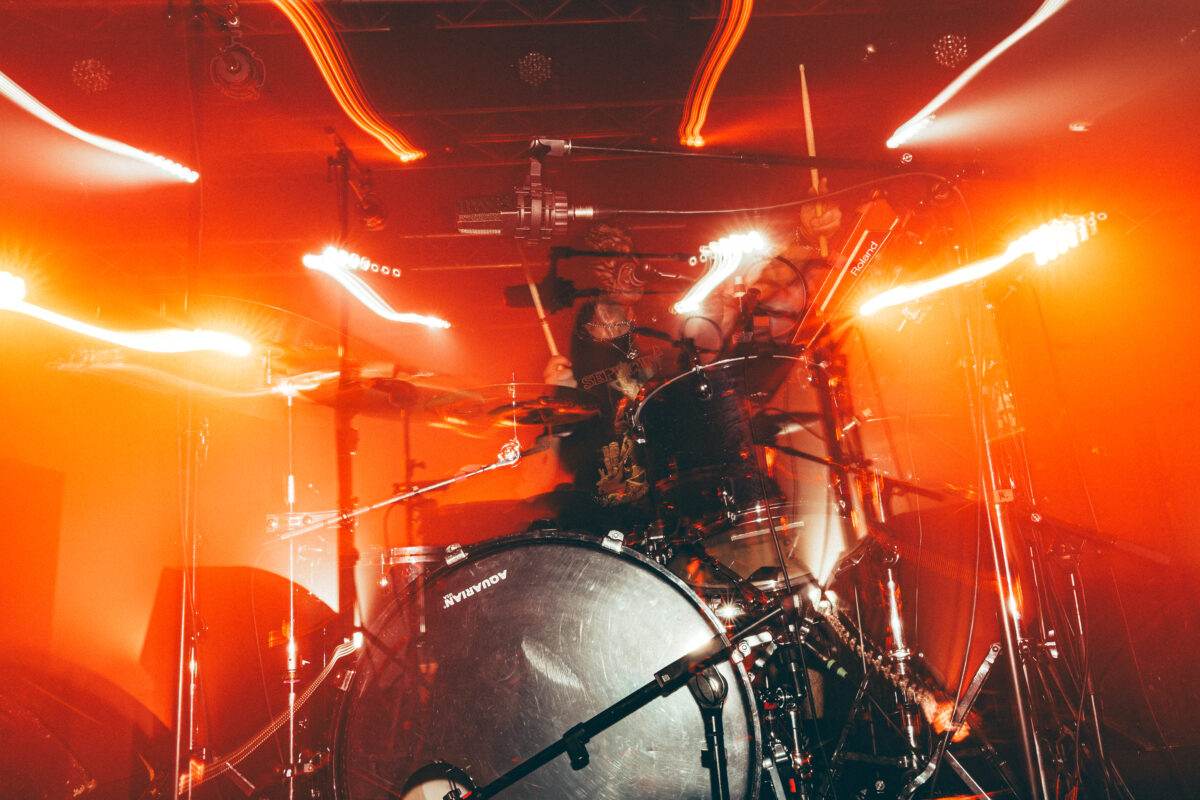
© Cédric Oberlin (@unsoundcolors)
MAQUINA
Halison : Exactement… mais non, on n’y a jamais vraiment pensé.
João : Oui, mais c’est une bonne idée pour la suite.
LFB : Quelle place occupe le silence dans une musique aussi dense que la vôtre ?
MAQUINA
Halison : Le silence, c’est surtout dans les moments de tension et de relâchement, quand on redescend un peu. Mais sinon… il n’y a quasiment pas de silence.
En fait, le silence existe surtout en live, parfois entre deux morceaux. L’idée, c’est de garder le set continu, sans interruption. Mais parfois je dois quand même m’arrêter pour boire de l’eau.
Cela dit, certains disent que c’est bien, parce que l’intensité est telle que quand on s’arrête, les gens peuvent respirer un peu, circuler, puis replonger dedans. Donc oui, le seul vrai silence, c’est parfois entre les morceaux en concert.
João : Mais c’est important quand même. Un ou deux moments de silence. Les pauses aident déjà : les gens relâchent la pression, puis ça repart. Faire vraiment silence, c’est difficile. Même si nous nous taisions, le public ferait du bruit en se demandant : “Mais qu’est-ce qu’il se passe ?”
Halison : Je pense que si on faisait de la pop, on pourrait utiliser davantage de silences. Mais nous, on travaille dans la répétition. Et dans la répétition, il n’y a pas de silence.
João : Et comme tu le disais : on aime cette idée de danser et jouer sans arrêt, du début à la fin.
LFB : Alors, selon vous, quelle est la durée idéale d’un concert ?
MAQUINA
Halison : Pour nous, 75 minutes, c’est parfait. On peut construire un très bon set comme ça.
LFB : Sans aucune pause ?
MAQUINA
Halison : Ce serait incroyable. Peut-être juste dix secondes pour boire de l’eau et repartir.
João : C’est comme à la salle de sport : tu tiens jusqu’au bout, puis après c’est bon.
LFB : Pour finir, j’aimerais que vous partagiez quelque chose que vous avez aimé récemment : un film, un livre, un disque…
MAQUINA
Halison : Je lis un livre qui s’appelle Future Days. Il raconte l’histoire du krautrock en Allemagne, surtout dans les années 60 et 70, quand cette musique fondée sur la répétition a commencé à émerger. Une musique plus avant-gardiste. J’avais commencé le livre il y a quelques années puis je l’avais abandonné. Là je l’ai repris depuis le début, et cette fois je vais le finir.
Mendy : Il y a aussi cet album de Battles avec Gary Numan. Toute la musique repose sur la répétition. Ce sont des riffs très courts, mais de minuscules variations suffisent à transformer complètement le morceau, son ambiance… Et pour moi, c’est ça la maîtrise de l’écriture.
Halison : Je dirais aussi Mirror Revelations. Ils viennent du Mexique et ils ont sorti un album il y a trois ou quatre jours. C’est très cool : répétition, motorik… Je crois que le disque s’appelle Ignea.
João : Un de mes films préférés, c’est Le Goût de la cerise d’Abbas Kiarostami. Je ne vais pas spoiler, mais c’est magnifique. Et comme livre… peut-être Une saison en enfer de Rimbaud.
LFB : Oh, tu as essayé de le dire en français !
MAQUINA
João : J’ai une édition bilingue, avec le portugais et le français côte à côte, donc je peux comparer.
ENGLISH VERSION BELOW
La Face B : Hello MAQUINA, how are you ?
MAQUINA
João : We are good !
Halison : I’m pretty well.
LFB : As a first question, I would like to know, is MAQUINA a feeling or a state ?
MAQUINA
João : Both ? Yeah, good question. I would say both. Yeah, it’s a state, but a feeling, it’s both of them.
Halison : Yeah, more like a movement, I would say, actually. But the state of mind, yeah, for sure, like experience a moment, yeah.
Mendy : Yes, I think so, it’s a state of mind, it’s more like a state of mind. At least for myself.
João : I like both.
LFB : With a name like MAQUINA, what role do you give to the machine in your music and your work ? Because I think it’s two different things.
MAQUINA
Halison : It can be almost the same. MAQUINA means machine, it’s the process of repetition and gears moving along with each other and creating the repetition and something with…
João : Yeah, something that doesn’t work without all the elements together.
Halison : If something fails, the whole thing fails, like a machine, it can also be something like that. In work, if we are not making music together in the same state or feeling the same vibration or the idea, some things can start to be a little bit rusty and not going as well. So, as a machine, it needs to be taken care and change some parts to make it more efficient also. And also in that kind of work.
LFB : I met you with your singles Agony, Pleasure, Pressure. I know you did an album before, but I didn’t know you that time. These two singles are quite physical. And I would like to understand between tension and trance, what are you looking for when you create something ?
MAQUINA
João : For this album (BODY TRANSMISSION coming July 10th at Fuzz Club – Editor’s Note), it was a clubbing centre to the clubbing vibe kind of music. But I also like a little heavy, so that’s it. Yeah, but trying to make it more danceable in some way.
Halison : Yeah, more danceable as possible to move the body.
LFB : As you said, your music inspires movement. It’s impossible when you listen to your music to see still images. What kind of visuals do you see ?
MAQUINA
João : A lot of textures, for sure.
Halison : Yeah. Clouds.
João : Grain and things, tangible things. It’s a little abstract, but with patterns, I would say.
LFB : Your latest video was very fuzzy…
MAQUINA
João : Yeah, textures.
LFB : Your music, when you record it, seems to get inspiration of the moment. Do you let some space for improvisation during concerts ?
MAQUINA
Halison : Yeah, a lot. It’s based in more open jams. We used to do this more, especially the first albums.
Even the albums were recorded like that, more like improvising, finishing the album in the studio, creating the groove and then working around the groove. When we were rehearsing. But then I go into the studio and just let open a little bit to see what we do in the moment.
And then in live concerts, it’s kind of like always playing a little different every time. Yeah, we never know. Sometimes things happen and we need to improvise. Even if we want to or not. If we make a mistake or not. Or if we’re really feeling that section of the song.
João : To make it longer. Like, let’s make it longer today.
Halison : You know, I love repetition. So if I keep the groove for a while and then I see that everyone is feeling, maybe we’re going to double it and repeat, repeat until the point to… To create the trance you were talking about. But it’s more in the moment than thinking a lot. So that’s more the feeling of the moment.
LFB : Do you record your live sessions ?
MAQUINA
Yeah.
LFB : And are you ready to take it for an album, for instance ? And you’re improvising something. You’re recording it and then you say, Guys, I have something, I have a new track here because you played it live and it’s a totally different track.
MAQUINA
Halison : Yeah. It can happen sometimes. Sometimes from the mistakes, sometimes from, you know, like trying something different out of nowhere. And then like going back to the studio and bringing that idea to working around and making a new song or something like this.
LFB : It would mean that… Imagine, tonight you’re playing Agony. New version of Agony. That would become a totally different track.

MAQUINA
Halison : It could be, it could be. Yeah, sometimes. But that’s like, you know, like that’s the thing. Because it depends how we go and how we are like going to the studio and rehearsing the songs.
More in the past, I would say, there was this guy, he came to me and he was saying like every concert I went, sometimes I’m listening to the song and after three or four minutes I notice that’s the song. That’s the song I know. After three or four minutes.
But now I think, especially with the new album, we did a little different. It was more like a surgical and thinking more about the structure of the music a little bit more than the previous tracks. So we play a little bit more like the studio live.
But there was always, yeah, like it depends how it goes. There was always this openness to do something different. But it depends how we are feeling as well. Sometimes we play the song as it is and then sometimes we change a little. But it’s more like to create this clubbing feeling.
LFB : Then you can cut and put things in the “wrong” order because it’s better like that.
MAQUINA
Halison : Yeah, sometimes, yeah.
LFB : I’d like to understand also, can a concert have an impact on the work around the volume ? I mean, when you record it on studio, you can’t really work on too loud tracks. People can listen to it loud, but how you deal with it ? How do you work with the volume ?
MAQUINA
Halison : We play loud. Everyone plays loud. Everyone plays loud. We play loud until the point the guitar is not loud enough. And then he put a little bit more. And then we are just going up until the point someone in the house will say, guys, you’re getting the limit. We cannot go further. So then we stop.
João : We see what is the boundary. And after, we work with that.
LFB : Then you say, it’s a boundary. Let’s go higher.
MAQUINA
João : Yeah. Sometimes we can’t. Sometimes we can’t. But it is what it is. But we have to play loud. The music demands it to play loud.
Halison : Yeah. Even the resonance, the feedbacks we get, everything around. Yeah. Sometimes if it’s not loud, the sound is not having the same. It’s really thin. It’s dying.
Mendy : Yes. And it doesn’t sound the same. Yeah. It’s really, yeah. The sound is thin. The notes don’t appear. João has a lot of difficulty. If something is not loud enough, João needs to be loud. So it’s something like that. Sound like excuses.
LFB : Would you be able to play outside? I mean, you’re playing inside. You don’t really play outside. But did you record outside just because there will be no boundaries ?

© Cédric Oberlin (@unsoundcolors)
MAQUINA
Halison : Exactly. I don’t. No, not really, actually.
João : Yeah, we never thought about it. But it’s a cool idea to do next.
LFB : What’s the place of silence in a music that’s quite dense like yours ?
MAQUINA
Halison : It’s when we do, like, a detention and release, and then sometimes you go down. But the silence is only between sometimes… Yeah, there’s no silence.
So, the silence is sometimes only live, sometimes, in between songs. Or contacts. Yeah, and then things get a little quiet, and then we start it again. The idea is to always keep going with a set, like a live set, non-stop. But then sometimes I have to stop to drink water.
But some people say that is good, because sometimes it’s so intense and so hot that when people stop, then they go around, circulate a little bit, and then go back to the part again. So, yeah, the only silence I would say is when we play live, sometimes between songs.
João : But it’s important. One or two moments. Silence, yeah. But the breaks already help, you know. To release a beat, people relax, but after, go up again. It’s hard to make silence, man. Even if people are going to do noise, even if we get silence, people are going to be like, what the hell ?
Halison : It’s kind of impossible. I think if we were a pop band or something, maybe we could make music doing more silences in the songs. Like, stuff. But we are like repetition. There is no silence in repetition.
João : And we like to, yeah, like you said, non-stop dancing. We like to be there from the beginning to the end, like non-stop dancing and playing.
LFB : So how long is supposed to be the perfect concert ?
MAQUINA
Halison : For us, 75 minutes is what we like to do. But doing this every day, we don’t know. But 75 minutes is perfect for us. We can do like a really nice set.
LFB : Without any break ?
MAQUINA
Halison : It would be amazing to do one day something. Maybe like 10 seconds, drink water and go back.
João : It’s like when you are in the gym, you know. You are there and after when you finish, you are okay.
LFB : And for the last thing, I would like you to share me something you really liked in movies, books, music…
MAQUINA
Halison : I’m reading this book called Future Days, which tells you this story about the Krautrock in Germany, the movement in the 60s and 70s especially, where this kind of music based on repetition started. More avant-garde, I would say. But yeah, this is the book I’m reading. I started a few years ago, but I stopped. And then I started all over again. And now this time I have to finish it.
Mendy : The album that has Gary Numan in it, it’s a glass drop by Battles, and it also has a lot of repetition in it. But it’s about gimmick music, like it has a very short riff, and then it goes along with the repetition. The tiny amount of things can change the whole song, the mood and everything, and that’s the mastery of songwriting, in my opinion.
Halison : I would say Mirror of Revelations. They’re from Mexico, they just released an album 3 or 4 days ago, and it’s a pretty cool album. It’s also repetition, motorik… Mirror Revelations. But yeah, it’s a pretty cool album. They did a new one. I think it’s called Ignea.
João : One of my favourite movies, Taste of Cherry, from Abbas Kiarostami. It’s from a guy that’s… I’m not going to spoil. Basically, I love it. It’s a great movie. And the book may be… Une Saison… From Rimbaud, you know ? Saison de l’Inferno…?
LFB : Oh, you tried to say it in French ! Une saison en enfer !
MAQUINA
João : I have a bilingual one, you know, that shows the Portuguese and the French, so I can compare it.